The memory of the holy martyrs Julian, Marcian and others who suffered with them for the icons
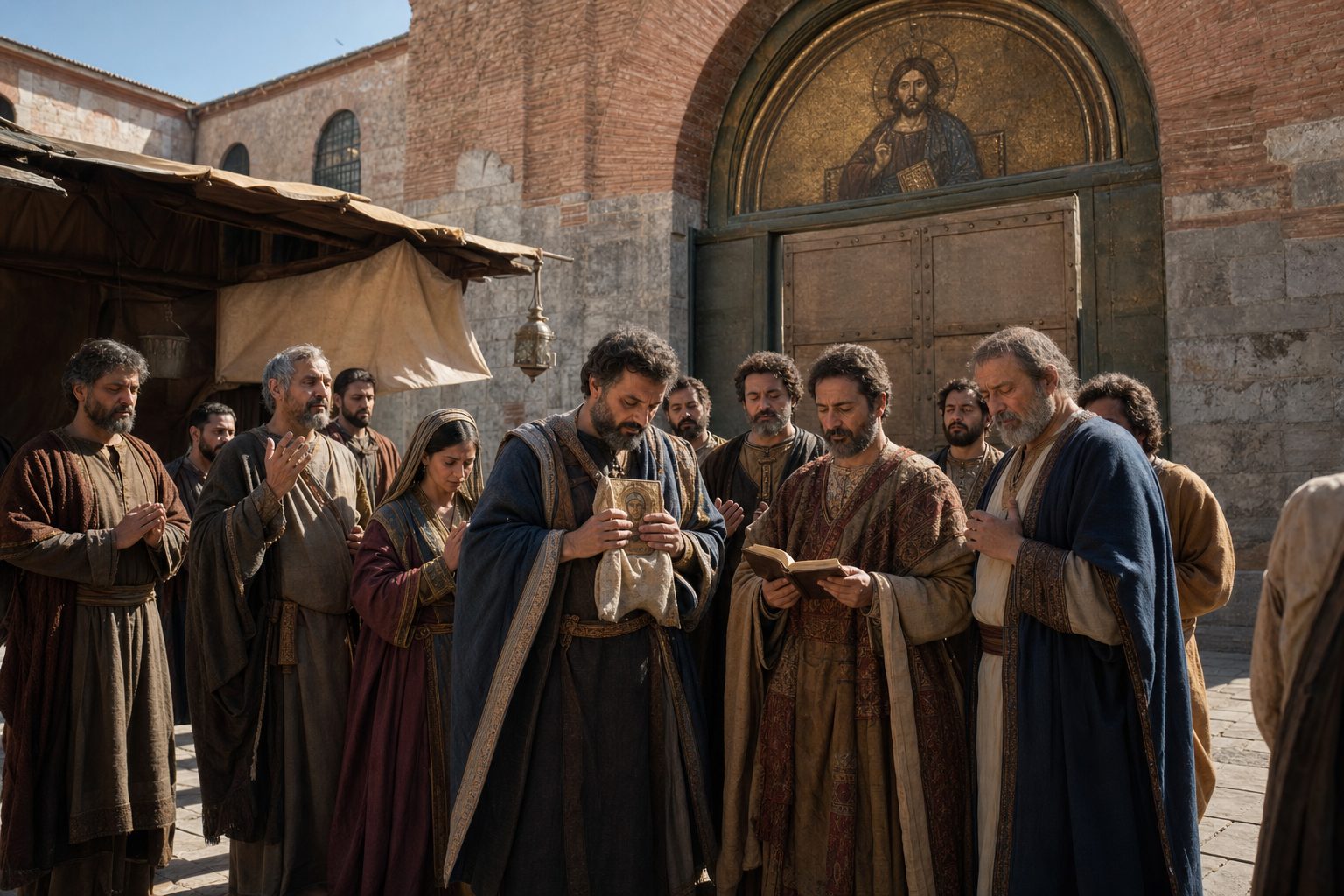
When the beast-named Leo the Isaurian (Emperor 716-741 C.E.) ascended the throne of the Greek kingdom, he began to persecute the Church of God, raising a new iconoclastic heresy in which holy icons were venerated as idols, and pious worshippers were persecuted.
for the idolaters.
Leo the Isaurian ordered the sacred icons to be thrown out of temples, houses and dwellings, and to be destroyed by throwing them into fire or water; those who did not share his heretical misconceptions he either deported to the extreme limits of the state or subjected to various tortures and even killed.
At the beginning of his persecution, he humiliated and beat the most holy patriarch of Constantinople, Herman [St.
Herman <unk> Patriarch of Constantinople 715-730] for opposing his orders; instead of the deposed patriarch, the heretic Anastasius was elevated [Patriarch from 730 to 754].
At that time, many devout Christians rebelled against heresy and suffered martyrdom, as did some of those we will discuss.
In Constantinople, since the time of Constantine the Great, there have been gates known as the Copper Gates, over which the image of the Savior, also of copper, had long been placed.
The wicked king and patriarch ordered this image to be taken down, and a ladder was set up, and one of the soldiers, a spapharius, began to climb; this disturbed the pious feeling of the huge crowd gathered at the gate; some of them seized the ladder and threw it down with the man on it.
A warrior to the earth, betraying his last death.
When the king heard of this, he sent against the Orthodox soldiers armed with bare swords, who killed many men and women, old and young; their number is known only to the Lord.
The most prominent iconoclasts among the crowd were captured alive. Their names were Julian, Markian, John, James, Alexius, Demetrius, Phocas, Peter, and Leontius.
After being severely flogged, they were thrown into prison, where they were kept in chains for up to eighty days, enduring cruel beatings. Each of them received five hundred lashes daily.
But the holy martyrs, being strengthened by the power of Christ, endured all things with courage, and did not lose their strength; and when the tormentor saw this, he commanded that their faces should be burned with hot iron, and that they should be brought forth into the open place, and slain with the sword.
Along with them, a noble woman named Maria Patrizia was decapitated for venerating icons and the bodies of the holy martyrs were thrown into the sea.
When the holy martyrs were captured, they took with them St. Theodosia the black-haired, who was accused of the same crime, <unk> she along with others participated in the fall of the stairs.
The holy martyrs who suffered for the image of the Saviour, all together stood before the Lord Jesus Christ, our God, to whom be the glory forever.
Amen [From the acts of these martyrs placed in the Acts of the Saints it can be seen: 1) that the main participation in the killing of a warrior who tried, at the will of the king, to throw the icon of the Savior from the Copper Gates, was taken by Maria Patrizia from a noble family; 2) the first assistant of Mary in the overthrow of the warrior was the protospapharium of St.
St. Gregory, and he suffered martyrdom for his feat; 3) this event happened on January 19; 4) the martyr Phocas most of the monuments call Fotium. <unk> After his death, on August 9, 730, the martyrs were buried in the area of Constantinople "Pelagiev", near the church of St. Feodor.
Their holy relics were found incorrupt after 139 years in the ground. Their relics were found during the reign of Patriarch Ignatius, as a result of a three-fold revelation he had during his sleep.]
On the same day, the memory of St. Psoy, a disciple of Pachomius the Great, who fought in Egypt in the 4th century.