The holy apostles (of the seventy) Prochorus, Nicanor, Timon and Parmenas
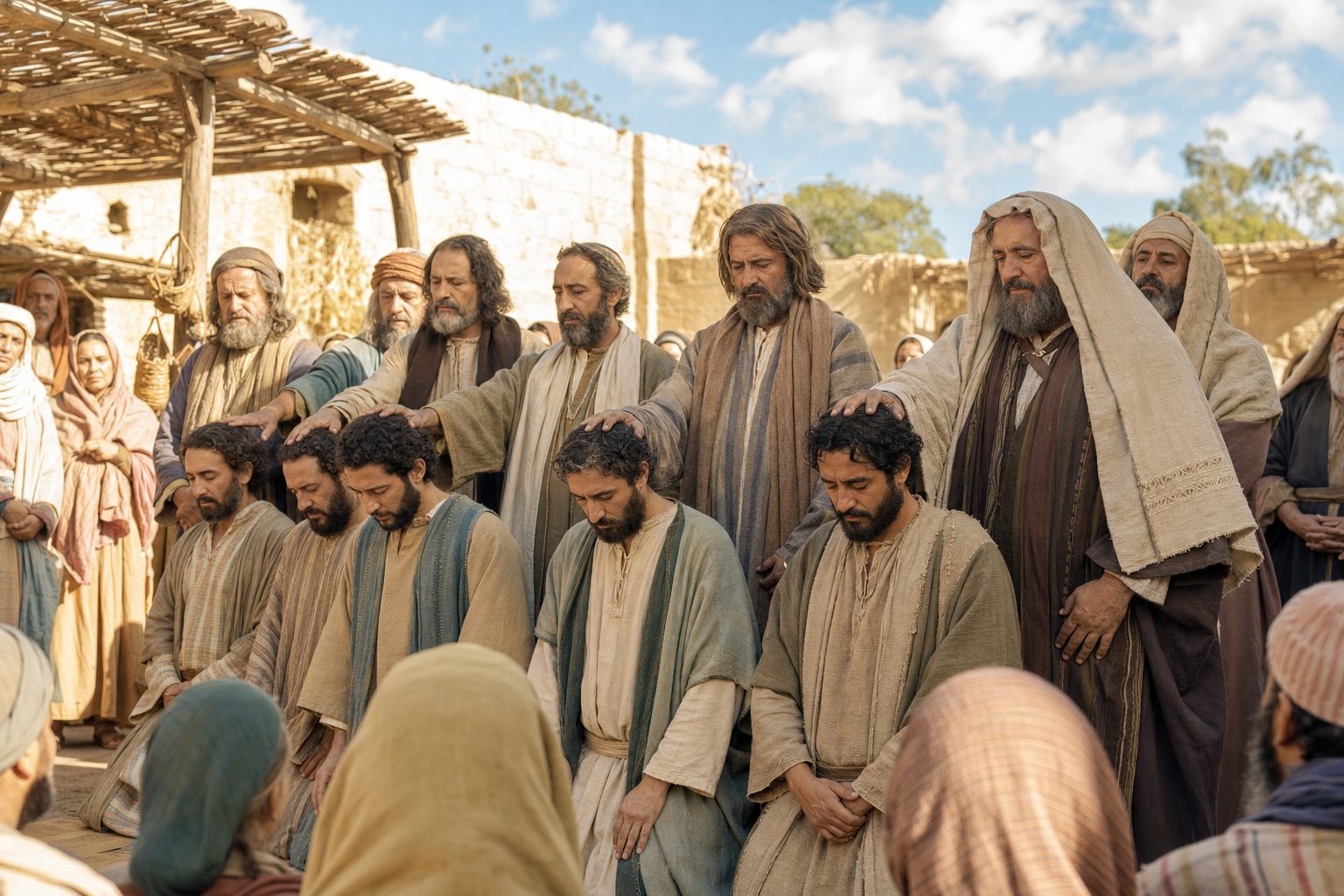
The number of the believers in Jerusalem increased greatly after the Ascension of the Lord and the coming of the Holy Spirit upon the Apostles; therefore, by the counsel of the Apostles who were then in Jerusalem, seven men, full of the Holy Spirit and wisdom (Acts 6:5), were chosen for the diaconal ministry.
Regarding their own election, the book of Acts reports: "In those days, when the number of the disciples was increasing, there arose a murmuring among the Grecian-speaking Jews against the circumcised Jews, because their widows were being overlooked in the daily distribution.
Brothers, choose seven men from among you who are known to be full of the Spirit and wisdom. We will turn this responsibility over to them, and they will devote themselves to prayer and to preaching the word.
And this proposal pleased the whole congregation; and they chose Stephen, a man full of faith and of the holy spirit, and Philip and Prochorus and Nicanor and Timon and Parmenas and Nicolas, a proselyte from Antioch; and they presented these to the apostles, and they prayed and laid their hands upon them.
Of all these chosen, the memory of the holy first martyr Stephen is honored on the twenty-seventh day of December; the memory of St. Philip is honored on the eleventh day of October; the memory of the other deacons, except for Nicholas, who is not counted among the saints.
The Apostle and Evangelist John the Theologian in the Apocalypse (2:6,15). It is supposed that the deacon Nicholas misunderstood Christ's teaching on love and Christian freedom and was a preacher of unbridled carnal love. However, Clement of Alexandria testifies that the deacon Nicholas led a strict and pious life, had a wife and children, and his daughters grew old in virginity.
The Church honors them even today, despite the fact that they died at different times and in different places, preaching the name of Christ and stamping their preaching with martyrdom.
He was appointed bishop of the city of Nicomedia by the Apostle Peter, as the blessed Simeon Metaphras tells us.
In 904 the Arabs threatened to destroy the city, convincing their leader to take a ransom for the city; to the end of his life he was a patrician and magistrate.
Simeon did not limit himself to a single collection of ancient tales about the lives, exploits and sufferings of the saints, but retold or translated them; hence his nickname "Metaphrastic" (from the Greek to retell, to translate).] in the story about the life and exploits of the holy Apostle Peter (under June 29).
After the Assumption of the Mother of God, Prochorus was the companion and collaborator of the holy Apostle John the Theologian [His memory on September 26 and May 8].; together with him Prochorus traveled through many countries, taking everywhere suffering from pagans for the evangelization of the name of Christ; together with John the Theologian Prochorus was exiled to the island of Patmos; here he wrote down everything he heard from St. John the Theologian, who spoke by revelation of God [According to tradition, St. John the Evangelist was the author of the Gospel of John the Evangelist].
Prochorus wrote the Gospel from the words of St. John the Theologian.]; after this, St. Prochorus again labored in Nicomedia, where he was the first bishop; here he turned to the Christ of the Gentiles, multiplying the newly assembled church.
He was the author of a number of works, including a history of St. Peter and later the bishop of Nicomedia. He suffered for confessing the name of Christ in Antioch on 9 August. (2) He was a disciple and companion of St. John the Evangelist.
However, we cannot say with certainty that two persons with the name of Prochorus should be distinguished; perhaps Prochorus the deacon and Prochorus the companion of St. Apostle and Evangelist John the Theologian <unk> one person, as St. Dmitry Rostovsky accepts.]
St. Nicanor suffered on the same day as the stoning of the holy first martyr Stephen; at this time a cruel persecution was raised against the church of Jerusalem; St. Nicanor, like the first martyr Stephen, was martyred with two thousand men who believed in Christ.
St. Timon was appointed by the holy Apostles as bishop of the city of Bastoria, which was in Arabia; for preaching the name of Christ he suffered much from both Jews and Gentiles; finally he was thrown into a very hot furnace, but he suffered nothing from the fire and came out of the furnace unharmed.
St. Parmenus diligently performed the ministry entrusted to him by the holy Apostles; he died before their eyes and was buried by their hands and was mourned by them.
The Apostles of Parmenus are dated to the reign of Emperor Trajan (98-117), and to the last years of his reign.] .Condak, vowel 1: Deacons of honesty and self-seekers of the Word, and vessels of the chosen manifested faith, Nicanor, Prochorus, Parmenus and Timon, the glorious: the same day we celebrate your holy memory, in joy of heart pleasing you.
The first voice.
Deacons honest and self-assured of the Word, and vessels of the elect manifested in faith, Nicanor, Prochorus, Parmenas, Timon, glorious: therefore this day we celebrate your holy memory, in the joy of your heart pleasing you.
1 Some of the church writers (Saint Irenaeus of Lyons, Epiphanius of Cyprus, Blessed Jerome, etc.) consider the deacon Nicholas the founder and head of the sect of the Nicolaitans, whom the Apostle and Evangelist John the Theologian denounces in the Apocalypse (2:6,15). They suggest that the deacon Nicholas misunderstood Christ's teaching about Christian love and freedom and was a preacher of unbridled carnal love. However, Clement of Alexandria testifies that the deacon Nicholas led a strict and pious life, had a wife and children, and his daughters grew old in virginity.
3 Simeon Metaphras <unk> the most famous church writer of the 10th century; born in Constantinople; secretary under the emperors Leo Philosophus and Constantine VII; fulfilled important diplomatic assignments; saved Thessaloniki from the destruction threatened by the Arabs in 904, convincing their leader to take a ransom for the city; to the end of his life he was a patrician and magistrate. For his pious life he was considered a saint by the Church (his memory is celebrated by the Church on November 27).
6 According to some scholars, two persons with the name of Prochorus should be distinguished: 1) Prochorus the deacon, <unk> companion of St. Peter the Apostle and later bishop of Nicomedia. This Prochorus suffered for confessing the name of Christ in Antioch on August 9. 2) Prochorus the later living, disciple and companion of St. John the Evangelist. This Prochorus is considered to be the composer of the story of the life and miracles of St. John the Evangelist, from the Assumption of the Mother of God to his death.
8 The memory of St. Timon is commemorated by the Church on December 30 and January 4 (together with the Council of 70 Apostles). 9 According to some researchers, St. Parmenus preached the Gospel in Macedonia.