The suffering of the holy martyr Apollinarius
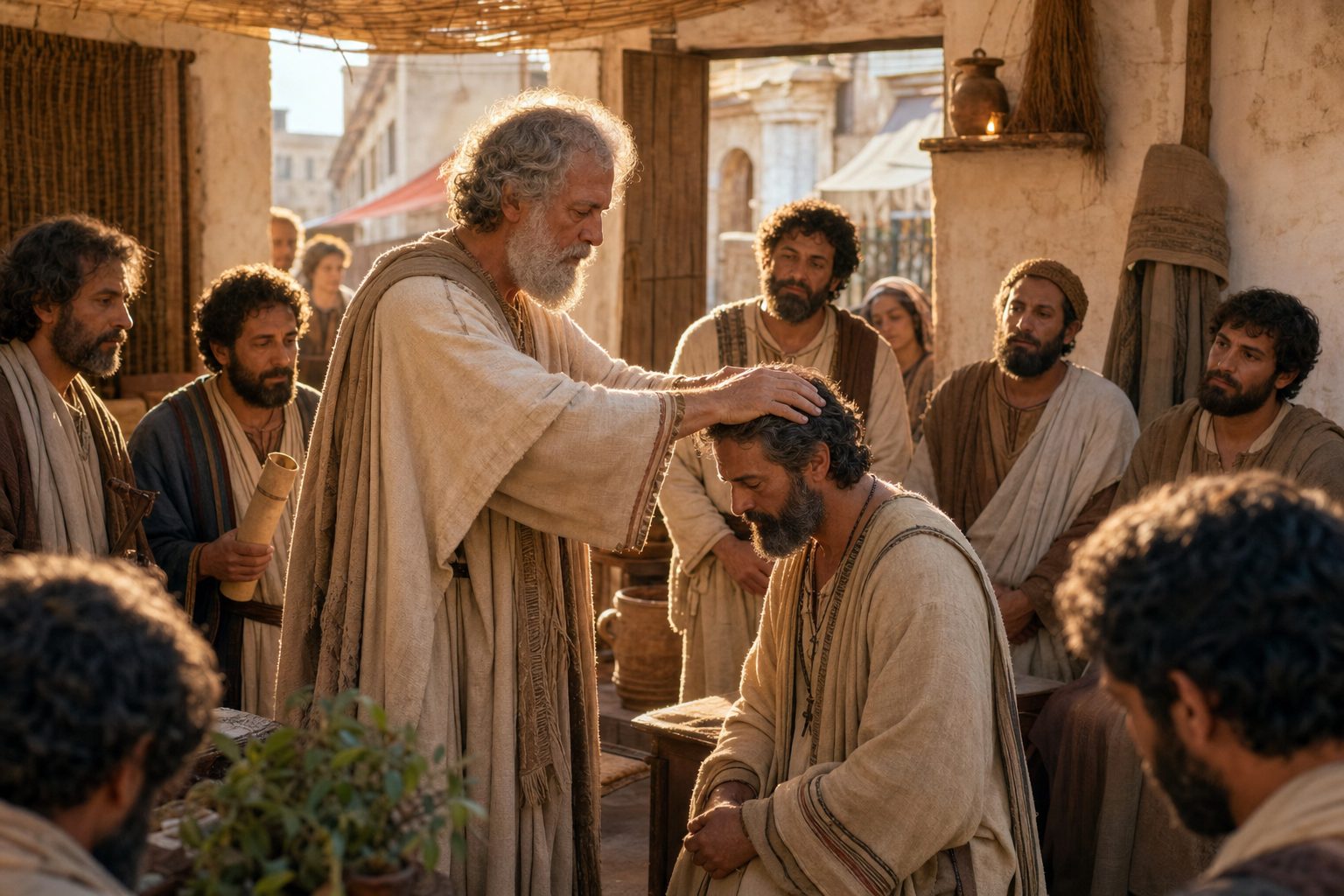
23 July In the days of Claudius Caesar [Claudius - Emperor 41-54 C.E.] St. Peter, Apostle of Jesus Christ [Memory of St. Peter 29 June] with many accompanying Christians came from Antioch to Rome [The capital city of the Roman Empire, lies in central Italy on both sides of the river Tiber, at its mouth in the sea.]; here at first, having entered the Jewish congregation, he called himself a Jew.
He began to preach the Christ Jesus, proving from the Scriptures that he really was the Son of God, and explaining all the signs that the Lord Jesus had performed in Israel.
When the holy Apostle Peter spoke in the Jewish synagogue every day, many of the Jews who believed not only heard the apostle's words but also many of the Romans who accepted his word with joy.
And when they had believed in Christ, they were baptized. And after a little while the apostle Peter said to Apollinarius, who had come with him from Antioch, "If you have been well instructed in the knowledge of Christ, the Son of God, and have known all his divine works, then receive the sanctification of the Holy Spirit and go to the crowded city of Ravenna.
In 254 B.C.E. the city was not subject to the Romans; the latter gave it self-government and various privileges and benefits. In the days of the Roman Empire, Ravenna was one of the important stops of the Roman fleet: a port was arranged here by Augustus.
After the fall of the western Roman Empire, Ravenna was taken by Odoacro, the king of the Reguls; in 493, after a long siege, Ravenna was taken over by Theodoric the Great. From 555 onwards, the Byzantine rule began, which lasted for about two centuries.
Ravenna became the property of the noble family of Polenta, which was previously a vassal of the pope. In 1441 Ravenna was taken over by the Venetians, from the hands of the latter in 1509 it again passed into the hands of the pope. In 1860 Ravenna was included in the Italian kingdom.
- Just like Rome, Constantinople and Thessalonica Ravenna is remarkable with monuments of ancient = Christian art from the time of his transition to Byzantine art.] and, without fear, preach the name of Jesus Christ there.
When Paul had finished speaking, he sent Apollinarius away, saying, "I am sorry. " When he came near the city, he entered the house of Irenaeus, a centurion, and stayed there as a guest.
"Father, I am a stranger here. I have a son who is blind. Heal him so that he can see. I believe in your God and I will follow him".
"God Almighty, bring the knowledge of your Son into this city, so that not only the physical but also the spiritual eyes of these people will be enlightened, so that they may know you, the only true God and our Lord Jesus Christ, whom you have sent to save the world (cf. John 17:3).
Immediately he received his sight and fell at the man's feet. Then he and his whole family believed and were baptized into the river that flows near Rabena.
Now there was a woman in that city named Theophilus, the wife of a Roman centurion, who had been bedridden for many years and had not been able to get well.
"A stranger lives here who has made my son blind. If you send for him, he can heal your wife. " The commander asked", Where did this man come from? " The commander replied", He is a Roman citizen. " The commander said, "I don't know. He seems to be a Greek".
When St. Apollinarius entered the city of Ravenna with Irenaeus, he made the sign of the cross and prayed: "O God, who hastens my teacher Peter, hasten me also, that your holy name may be glorified in this city and that your will may be done here". When the saint entered the tribune's house, the tribune greeted him: "Good that you have come, O doctor! What can be more pleasant than cold water for a thirsty man?"
"May he rest", said St. Apollinarius, "the blessing of our Lord Jesus Christ be upon you". "Who is He whom you have called?" asked the tribune. "He is the Son of the living God (cf. John 6:69) who renews the whole lost world", replied Apollinarius.
"I see that you are a Galilean [Galilee - a region in northern Palestine; here the Lord Jesus Christ spent his childhood and youth; Galilee was primarily the place of his preaching; therefore the Lord Jesus was called a Galilean (Matthew 26:69).
In the 4th century, the Greco-Roman emperor Julian the Apostate died (in 363) with these words addressed to Christ: "You have overcome me, Galilean!" - hence the name Galileans of the Lord Jesus.] , - said the tribune. - True, so, - confirmed the saint. - Do you know how to heal? - asked the tribune. - No, - answered the saint, - I know nothing but the name of Jesus. - And what power in the name of Jesus? - said the tribune.
But he said, "Call the soldiers here and see how powerful my Lord Jesus Christ is". So the commander called them together and said to the saint, "Look, my wife has been bedridden for years, and she has not been helped but rather has got worse.
"In the name of our Lord Jesus Christ, get up, and do not be afraid of anyone else. " At that very moment the woman was healed. She stood up and said in a loud voice", There is no God but Jesus, whom you preach.
So the centurion and all his soldiers were afraid, and they said, "If God is for us, he will help us in this battle". So the centurion and his wife and children and all his household believed. Many non-Jewish people also believed and were baptized.
From that time on, St. Apollinarius began to reside in the city in the house of the tribune, and a large number of people came to him every day, and he taught them secretly to believe in Christ and baptized them; and those who believed gave their children to the saint for the teaching of the book.
He remained there for 12 years and ordained two presbyters, Aderetus and Kalochirus, and Markianus, a man of noble birth, and the philosopher Leucadius as deacons and six men as clerics, and prayed with them day and night, praising God.
But as the number of Christians increased, and the name of Jesus Christ and His preaching spread among the people, it was impossible for the man of God to remain unknown, and it was reported to the governor of the city, Saturnus.
"Who then is the Christ? " the prince asked". He is the Son of the living God, to whom everything in heaven and on earth and in the sea belongs.
Then the priests of the idol said to the saint, "Now go and see his great temple, beautifully decorated, and in it you will see the image of the invincible Zeus and worship him". And they brought St. Apollinarius to that temple, and when he entered it and saw the rich ornaments, he laughed and addressed the priests with this speech: "Look how much gold and silver has been gathered here from nothingness.
Then the wicked were filled with wrath and anger, and smote the holy man, and bound his feet with ropes, and dragged him out of the city, and cast him as though dead upon the seashore; and Apollinarius, being barely alive, the disciples took him, and lodged him in the house of a widow, who believed in Christ, and took care of him.
And it was told in his house, that Apollinarius the servant of God was alive, and that he was in the house of a widow. And his wife came in haste, and fell at his feet, and besought him that he should come to her house, and heal her husband.
and said, "Get out of here, you servant of the living God! Otherwise you will be bound in chains and thrown out of the city".
"Lord Jesus Christ, who shut this man's mouth so that he cannot call upon demons to help him, open his mouth now, so that he may call upon your blessed name and believe that you are the living God forever".
"There is no other God but Apollinarius". More than five hundred men believed in Christ that day and were baptized. A few days later, the wicked, angered by demons, again seized St. Apollinarius and severely beat him, forbidding him to preach about Jesus or even to mention his name.
And the heathen, because they could not bear his testimony, put him barefoot in the hot coals, and tormented him, and burned him in the fire; and he preached the gospel of Christ with all the more power. And when they had bound St. Apollinarius by the feet, they dragged him out of the city, crying, Thou art a healer, but if thou wilt live, enter not into the city.
And he built a church by the sea, and baptized them that believed in Jesus Christ in the sea.
After a few years, the saint was banished by the infidels and went to the Italian country of Emilia, where he preached and led those who could to the holy faith. At that time, at his command, the presbyter Kalokires ruled the church; he also showed great signs by the power of the name of Jesus Christ.
At that time Ravenna had another ruler, named Rufina, who had only one daughter, and she was so ill that they were already waiting for her death. Hearing of St. Apollinarius, the ruler ordered with honor to bring him to his house so that he might help his daughter. When the holy bishop and the clergy entered the prince's house, the sick girl died.
"It would be better for you not to come into my house, for for your sake the great gods have been angry with me and have not wanted to spare my daughter from death". "I swear to you by Caesar's health", replied the saint, "that you will not prevent your daughter from following her Savior, and you will see the power of the Lord Jesus Christ I preach".
"I know", said Rufus, "that my daughter is dead, but if I see her alive and speaking, I will praise the power of your God and not stop her from following her Savior".
"Lord Jesus Christ, my God, who fulfills all the prayers of your apostle Peter, my teacher, fulfill my request, and resurrect this girl, because she is your creation, so that those who are coming will see your power and know that there is no god but you. " Then he touched the dead man and said, "Get up and confess your Creator".
At that, three hundred and twenty - four of them were baptized. Many also of the Gentiles believed and were baptized.
But Rufus, the Roman governor, being a believer, withheld himself, because he feared the emperor; but because he loved the saints, he ministered to them in secret.
Then Caesar sent Messalinus, a governor of the province of Rome, and Apollinarius ordered that the Jews be forced to abandon their worship of pagan gods or to be banished to the most distant country.
And when he had called Apollinarius in to the praetorium, and had asked him who he was, and where he was from, and what he did, he said, I am a Christian, a disciple of the apostles, and of the living God, who made heaven and earth, and the sea, and all things that are in them.
"Is this not the Christ whom you preach, the one who was killed by the Jews years ago, the one who claimed to be the Son of God? If he were God, he would not die or accept blasphemy.
"This Jesus Christ", said St. Apollinarius, "of whom you speak, God was, is, and will be forever. To free the human race from the bondage of the enemy, He humbled Himself and was incarnated by the Holy Spirit in the womb of a pure, virgin, and was born of Her without words.
"God was in the pure flesh and performed wonders and signs, and when he was taken by the Jews and crucified, he suffered the acceptance of his flesh by the Most Holy Virgin, but the Godhead remained alien to suffering and immortality; by this Godhead and flesh he rose from the dead on the third day and appeared to many, ascended into heaven, from where he descended.
(Mark 16:17-18) Jesus also gave authority to his followers to exercise faith in him.
"You cannot persuade me", said Messalinus, "to become a follower of an unknown God, whom Caesar and the senators do not acknowledge; but go into the capitol of the city and offer with your hands the smoke to the great and fearfully thundering god Zeus; or if you do not wish to do this, I will deliver you to various torments and send you into exile.
"If I enter the cathedral, I will not offer incense to the demons, but I will offer a sacrifice of praise to my Lord Jesus Christ", answered the saint. The idol priests shouted, "May Apollinarius be tortured!"
"Bring him to the place of torment", cried one of the priests, "and torture him more cruelly, until he gives glory to the immortal gods". But in the midst of these most cruel tortures, St. Apollinarius cried out, "I confess to the living God, the Lord Jesus Christ, and to no one else".
"It is written", answered the martyr, "that he who endures to the end shall be saved". (Matthew 24:13) And if anyone dies in Christ, he shall live: this is the reward for a Christian.
In the meantime, he ordered a ship to be prepared to take the martyr into captivity in Illyricum [Illyricum, or Illyricum, the Roman province mentioned by St. Paul in his letter to the Romans as the limit of his apostolic activity (15:19).
The Romans distinguished between illyria barbara, the northern mountainous country, and illyria graeca, the coastal country inhabited by Greek colonists. Some of the 70 apostles preached in Illyria.] One of the tormentors of the holy servant, who most of all scoffed at the passionate, was suddenly overcome by a furious demon, fell to the ground and died, for he had torn his tormented soul from him.
(Matthew 10:28) The name comes from a Hebrew word that refers to the valley of En-non near Jerusalem, where children were burned in honor of Molech.
King Josiah abolished the horrible and God-dishonoring custom of such sacrifices; after this, the corpses of executed evildoers, fallen and all uncleanness began to fall into the valley of Enon; to destroy the stench and infection, all this was given over to fire.
The Christians, seeing the cruelty of the tormentor, could not bear it any longer (they were many), but, moved to anger, they made a popular revolt; they threw themselves on the pagans and killed several people; they wanted to kill Messalina, but when he noticed the noise and the popular revolt, he was afraid and immediately, seizing his place, ran away and hid somewhere in a fortified building.
And he commanded the soldiers to take Apollinarius, and to cast him into prison, and to bind his feet in fetters, and to give him neither bread nor water, that he might die, and that he might faint with hunger and thirst.
Four days later, Messalinus, hearing that the Christian teacher Apollinarius was still alive in the dungeon, ordered him to be chained in heavy iron fetters, secretly put on a ship and sent into captivity.
And it came to pass after a few days, that a great tempest rose suddenly, and the sea was exceedingly tempestuous, and the ship was broken by the pressure of the waves, and they were all drowned; and only St. Apollinarius and three clerics and two warriors with them survived; and they were kept by God, and came safely to the shore; and the iron fetters in which the saint was bound slept with him, broken by an invisible hand, when the ship sank; and they that were saved from death came to the shore.
"Where shall we go, sir? " they asked". What shall we do? " He replied", Believe in the Lord Jesus and you will live".
They immediately cursed their idols and were baptized in the name of the Father, the Son, and the Holy Spirit. Paul went from place to place with three clergymen and two newly enlightened soldiers until he came to Mysia, where no one received them.
"Believe in the Lord Jesus Christ", he replied. "My God will heal me", the sick man replied. St. Apollinaeus called on the name of the Lord Jesus and touched the leper, and he was healed immediately.
And when he was come to Phrygia, he stayed by a pagan shrine, where the idol of the unclean god Seraphim stood, which talked with his worshipers; for the demon that sat in the idol answered them that offered sacrifices, and inquired of all things.
But as they were trying to tempt him, Paul said to them, "I will not be released until someone has been arrested and put out of the country for the name of Jesus we are preaching.
And when they had found him, they beat him exceedingly; and when they had brought him to sea, they found a ship sailing for Italy, and having entreated the governor of their country, who had sent the ship, they put a saint on it, saying, From whence art thou come, return.
And when the wind had blown, they came to Italy. And when they had gone ashore with the disciples, the man of God went to the city of Ravenna to his flock, and when he was come to Ravenna after three years' exile, he was received with great joy by the believers.
And it came to pass after a long time, that when the priest of God was ministering in the church of a certain man of Cyrene, a great multitude of Gentiles came upon it, and scattered the people, and took the shepherd of the church of Apollinarius, and smote him, and brought him bound into the city, and delivered him to the chief priests of the temple of Zeus.
"He is not worthy to stand before the great god Zeus, whom he has often blasphemed, but let him be brought to Apollo". When the saint was brought to the temple of Apollo, he prayed to my Lord, and the idol immediately fell to the ground and was shattered into ashes, and a short time later, that useless temple collapsed.
When the Christians saw this, they praised their Almighty God, but the pagans, seizing Apollinarius, brought him to the prince Taurus and handed him over to him to be put to death. The governor, having called together all the councilors, asked the prisoner in their presence, "By what power does he perform these miracles and heal the sick?"
"I have a son who was born blind", the judge replied. "If you make him see in the name of your Christ, we will believe that he is God. But if you do not, we will hand you over to the flames and you will die".
And immediately the man who had been blind from birth received his sight, and all the people were amazed and said, "The power of the true God is indeed with him who does these miracles". And many believed in Jesus. The ruler, having delivered the saint from the hands of the unbelievers, sent him by night to his estate six thousand [milliaire or mile] [equal to eighty-eight stadia] outside the city, under the pretext of keeping him there in chains.
But the saint remained in that city for four years, not in chains, but in freedom, and all the believers and many of the Gentiles came to him; and he converted them to the holy faith by preaching the gospel, and he baptized, and all the sick who were brought to him he healed.
If thou destroy not Apollinarius the sorcerer, who is evil to thy kingdom, the worship of the gods shall perish, and the glory of Rome shall be diminished; for he daily seduces many nations with his sorceries, and blasphemes the immortal gods, and destroys their temples; but if one of them be destroyed, the glory of Rome shall be preserved for ever.
If any man offend and profane the gods, let him recompense them with gifts, or let him be driven out of the city; for it is not lawful to avenge a man for the gods, for they themselves may avenge themselves on their enemies when they are angry.
When this answer of Caesar came to Ravenna, the patrician Demosthenes, who had then taken the reign over the city, seized the saint of the god Apollinarius, who was already old in years and physically weakened by many tortures.
And Demosthenes gave the holy man into the hand of a centurion, until he should decide what manner of punishment he should inflict upon him, and what evil places to cast him out.
and said, O my lord, my father, do not hasten to die, for thy life is very precious to us, for our well-being; but go out tonight to the village, where the sick are, and lodge there until the tumult of the people is abated.
But when he was gone, some of the idolaters, when they heard of it, ran after him, and found him in the way, and smote him, and cut him with the sword, till they thought him dead; and they left him, and went away.
Before his death, the whole flock gathered around him, and for a long time he taught them not to depart from the holy faith of Christ, to abhor pagan useless things, and he prophesied that there would be numerous persecutions against the church of Christ, also predicted that after all the severe disasters, there would be a widespread destruction of idols and the light of godliness would shine throughout the universe, there would be Christian kings, and Christians would offer sacrifices to the living God unhindered.
"He who lives by faith in our Lord Jesus Christ will never perish, but will live forever. " The holy priest and martyr of Christ bore witness to this in many other ways.
Passover of the saint of God Apollinarius Church of Christ twenty-eight years with a month and four days. The saint suffered on the tenth calendar of August (that is, July 23) in the reign of the Romans Vespasian, and we (Christians) have our Lord Jesus Christ with the Father and the Holy Spirit forever and ever. Amen [St. Apollinarius died about 75 A.D.; his body rests in Ravenna, in his name, and the holy hand is in Rome, in the church dedicated to him.]
I 'm going to have to ...