The Life and Suffering of the Holy Apostle Barnabas
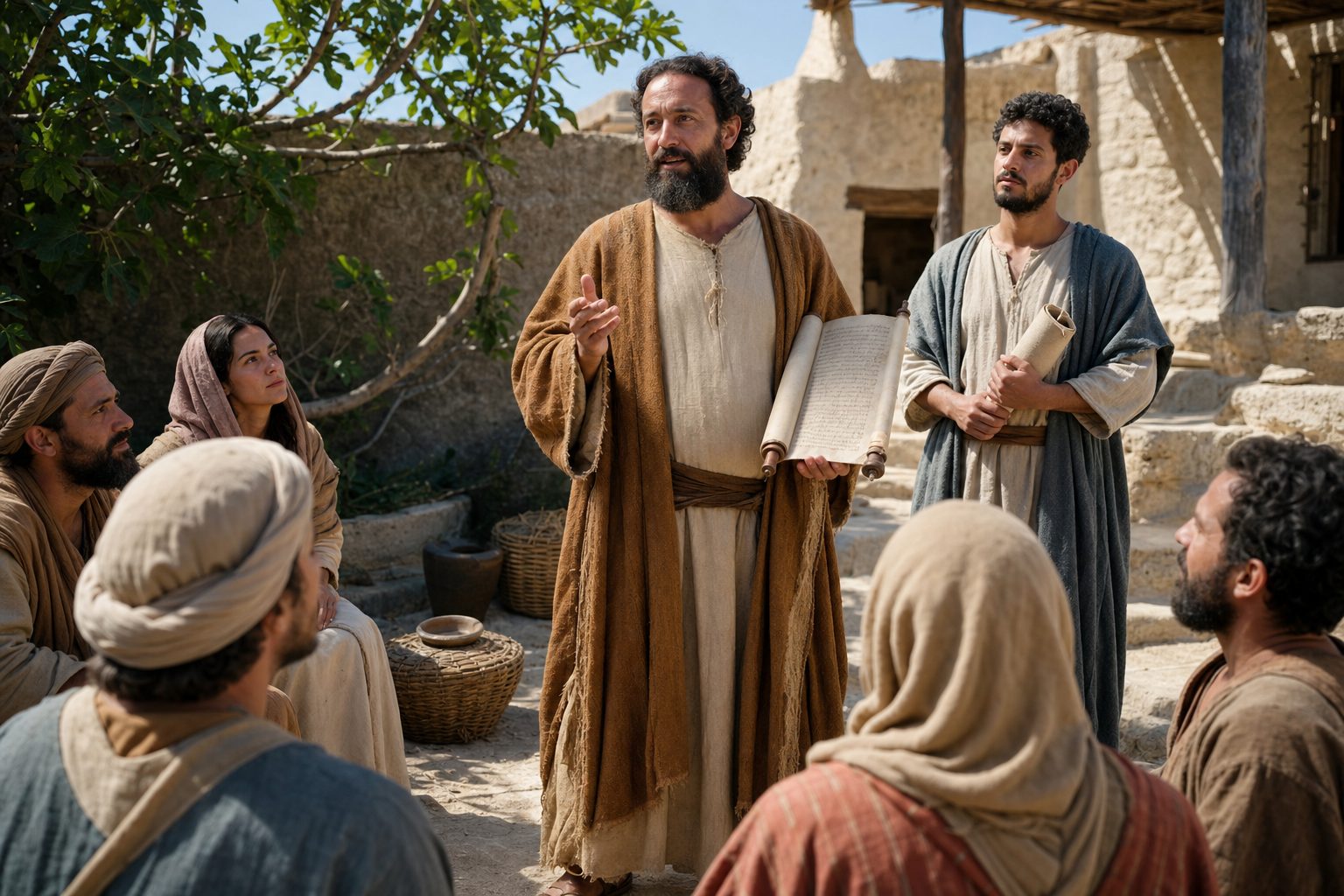
The holy Apostle Barnabas belongs to the face of the holy seventy apostles: Joseph was his original name, but later he was called Barnabas, as we shall say in our place.
He was born on the island of Cyprus [the island of Cyprus was located in the northeastern corner of the Mediterranean Sea] to Jewish parents who were of the tribe of Levi; from his tribe of Levites came also the ancient great prophets of God <unk> Moses [Moses - the famous leader and lawgiver of the Jewish people, the first sacred
A writer who lived in the 15th century B.C.
He received the Ten Commandments from God on Mount Sinai and saw the glory of God. All that he received from God, commandments and decrees, as well as the original history of the Jewish people, he set out in the first five books of the Bible (the Five Books of Moses).
The Church of 4 September.] , Aaron [Aaron - the first high priest of the people of Israel, brother of the prophet Moses (Ex.7:7) ] and Samuel [Samuel - prophet and judge of the people of Israel, who lived in the XI century BC. His life and activities are described in 1 Kings. His memory is commemorated on August 20.] .
Barnabas' parents had moved from Palestine to Cyprus because of the wars in Palestine. His parents were very wealthy and had their own village near Jerusalem, which was full of gardens and various fruits and decorated with a large building, as they had their own house here.
For from the time of the holy prophet Isaiah [Isaiah - a famous Jewish prophet who lived and acted in the eighth century B.C.E. under four kings of Judah; Uzziah, Jotham, Ahaz, and Hezekiah.
The prophecies of Isaiah concerning Jesus Christ are so clear and definite that the prophet Isaiah is rightly called the "Old Testament evangelist". His memory is celebrated by the Church on May 9.]
23), Jews living in distant lands, not understanding the spiritual meaning of these words, tried to have their own houses in Jerusalem; for this reason Barnabas' parents had their own house and village near Jerusalem.
When the child was brought up, he was brought up in the scriptures. When the boy was old enough, they sent him to Jerusalem to Gamaliel, a respected teacher at that time, so that he could teach Barnabas a more thorough understanding of the Hebrew Scriptures and the whole Law of God.
Here Joseph had among his peers Saul, who was later named Paul; and both were taught by the same Gamaliel, excelling in intellect, understanding of the Scriptures, and in virtuous living.
And Joseph came to the temple of Solomon every morning and evening, and prayed there earnestly to God, and fasted frequently and abstained greatly in the days of his youth; and he would not associate with the youths that were immoral, to keep his virginity pure; and he would not hear the words that the mind of Solomon had spoken.
He may have darkened his eyes, but he kept an eye on his heart and meditated on Jehovah's law day and night.
At that time, thirty years after our Lord Jesus Christ began to manifest himself to the world, he came from Galilee, where he taught in the temple and did many great and miraculous signs.
His, sweeter than honey and salt.
And when Joseph saw him, and heard the words of his mouth, he was filled with wonder, and marveled at the miracles that were done by him. And when he saw the man that was sick in the sheepfold, and how he healed him by his word, and many other marvelous works of Christ, Joseph's heart was filled with joy.
He loved the Lord, and when he came to him, he fell at his feet, and Joseph asked the Lord to bless him and to take him among his disciples.
And Jehovah, who searches the hearts, saw that Joseph's heart was pure, and he loved him.
Joseph first hurried to the house of his aunt, Mary, the mother of John, who was later called Mark, and said to her: "Come and see the One whom our forefathers were eagerly seeking to see; for the prophet Jesus from Nazareth of Galilee was teaching in the temple and performing great signs, so that the people were listening.
His is the long-awaited Messiah".
But when the woman heard this, she immediately left everything and hurried to the temple.
And now, if I have found favor in your sight, please, come into the house of your servant, and bless my household by your entrance".
When the Lord saw her faith, he went in and blessed her and all her household.
When the Lord was going back to Galilee from Jerusalem, Joseph and other disciples followed him.
And when the Lord desired to send His apostles to preach to "the lost sheep of the house of Israel" (Matthew 10:6) He saw that they were few, so He said, "The harvest is plentiful, but the laborers are few" (Matthew 9:37); for this reason the Lord appeared to the world and to the other seventy disciples, whom He sent ahead of Him two by two into the kingdom of heaven.
every city and village (Luke 10:1).
Among these seventy disciples of the Lord was one of the first and St. Joseph, renamed by the holy apostles Barnabas, that is, the son of consolation, because with his preaching about the Messiah who had come into the world, he comforted the people, who were eagerly waiting for the coming of the Messiah.
Just as the sons of Zebedee were called sons of thunder (Mark 3:17) because their preaching was to thunder like a thunderbolt throughout the universe, so this holy Joseph was called the son of consolation because his apostolic labors were to bring great joy to God's chosen ones.
And St. Chrysostom, explaining the reason for his renaming, says (Acts. 11): "I think he got his name by merit, for for that (to be a son of consolation) he was quite capable".
After the Lord's ascension to heaven, the holy apostles all lived together in Jerusalem, as is recorded in the book of Acts: "Now the crowd of those who had believed were of one heart and soul, and no one was saying that any of the things he possessed was his own; but they had all things in common.
For there was not a needy person among them; for all those who owned lands or houses would sell them and bring the proceeds of the things sold and put them at the feet of the apostles". - Acts 4:32, 34, 35.
Now Joseph, who was called Barnabas by the apostles, sold a field that belonged to him and brought the money and put it at the apostles' feet.
(Acts 11:24) He was " a good man and full of holy spirit and faith . "
But Saul, being very zealous for the traditions of his fathers, looked upon him as a man of sorrows, and despised him.
He did not even begin to speak against our Lord Jesus Christ, calling him the son of a carpenter, a man of human nature, delivered up to a shameful death.
When, after the murder of the first martyr Stephen by the Jews, Saul began to persecute the church, "entering into the houses, and dragging out men and women, and throwing them into prison" (Acts 8:3), then St. Barnabas mourned him greatly and prayed fervently to God, raising his pure hands, that he would enlighten the souls of the faithful.
He was eager to have Saul as a friend in the Christian faith as he had in the school of Gamaliel.
The tears and prayers of Barnabas were not in vain; when the hour of God's mercy came, Saul turned to Christ, being called by the voice of the Lord from heaven, on the road to Damascus.
The city of Damascus lies to the northeast of Palestine, at the eastern foot of Anti-Lebanon.]
But Saul, who had been a persecutor of the church, became a defender of the church. For having been baptized, he immediately went into the synagogues of the Jews and began to preach about Jesus, saying that he is the Son of God.
I was trying to help the Jews living in Damascus.
(Acts 9:26) When St. Barnabas met him, he said: "Saul, how long will you keep on blaspheming the great name and on persecuting the faithful ones of him?
How long will you keep ignoring the terrible mystery foretold long ago by the prophets, but now fulfilled for our salvation?"
Now I know that what you have told me about Christ is true. He whom I formerly cursed, calling him the carpenter's son, I now confess to be the only Son of God, who is with the Father and the firstborn, "who is the radiance of the Father's glory and the image and likeness of his being", (Hebrews 1:3) in these last days.
"He emptied himself, taking the form of a slave" (Philippians 2:7) and became a perfect man, born of the Blessed Virgin Mary, taking free suffering and the cross; then he rose again on the third day, appeared to you, his apostles, ascended into heaven and is seated at the right hand of God the Father; he will come again in
to judge the living and the dead. His kingdom will never end".
When Barnabas heard these words from the former blasphemer and persecutor, St. Barnabas was amazed and wept with joy. He embraced Saul and said:
"Saul, who told you to say these things? Who told you to say that Jesus of Nazareth is the Son of God?
Then, with tears in his eyes and a broken heart, Saul replied: "The Lord Jesus Christ himself, whom I, a sinner, blasphemed and persecuted, taught me all these things, because he appeared to me as if by accident, and now I hear his divine voice in my ears.
I fell to the ground and was terrified. I heard a voice say to me, 'Saul! Saul! Why do you persecute me?' 'Who are you, Lord?' I asked. 'I am Jesus, whom you are persecuting,' the Lord replied.
I prayed, 'Lord, what shall I do?' And he taught me all the things I should tell you.
He that persecuted us is now our own. He that hated us is now our own. He that was our enemy is now our friend and our partner in the vineyard of Christ.
He took him and told them how Saul on his journey had seen the Lord and that the Lord had spoken to him, and how in Damascus he had preached fearlessly in the name of the Lord. At this they were filled with joy and praised God.
So Saul stayed with them and moved about freely in Jerusalem, speaking boldly in the name of the Lord to both Jews and Greeks.
They were amazed that the man who had formerly persecuted those who called on the name of Jesus was now preaching the good news of Jesus. So they tried to kill him.
When the brothers learned of this, they took him down to Caesarea and sent him off to Tarsus, where he continued to preach the Lord Jesus.
At the same time, the Lord Jesus Christ was being preached in the city of Antioch.
The murder of Stephen began a great persecution of the church at Jerusalem. All but the apostles were scattered throughout Judea and Samaria. Some went as far as Phoenicia, Cyprus and Antioch, telling the word of God to no one.
(Acts 11:19) But they also began to preach the good news of the Lord Jesus to the Greeks. "The hand of Jehovah was with them, and a great number that became believers turned to the Lord".
News of this reached the ears of the church at Jerusalem, and they sent Barnabas to Antioch.
When he arrived and saw the evidence of the grace of God, he was glad and encouraged them all to remain true to the Lord.
But since the number of disciples was increasing more and more, and the harvest was not plentiful, Barnabas went to Tarsus to look for Saul, and when he found him, he brought him to Antioch.
Christ to God, bringing both Jews and Greeks to faith in Christ.
So for a whole year Barnabas and Saul met together in the temple courts and taught, and for the first time the disciples were called Christians.
And they did this, sending, each according to his ability, with Barnabas and Saul, to those who were in need among the brothers who were dwelling in Judea.
(Acts 11:28) The apostle Paul was in Palestine in 44 C.E., during the reign of Claudius Caesar.
Many secular writers of the time, such as Josephus, Flavius, Tacitus, and others, testify to the severe famine that raged in Palestine at that time. Later, during Apollos' stay in Caesarea, he also foretold that he would be imprisoned.
And when Barnabas and Saul, who is called Paul, [the story of the life and work of the apostle Paul, set forth in the book of the Acts of the Apostles, see also St. Paul and the Apostles, Acts of the Apostles, Acts of the Apostles, Acts of the Apostles, Acts of the Apostles, Acts of the Apostles, Acts of the Apostles, Acts of the Apostles, Acts of the Apostles, Acts of the Apostles, Acts of the Apostles, Acts of the Apostles, Acts of the Apostles, Acts of the Apostles, Acts of the Apostles, Acts of the Apostles, Acts of the Apostles, Acts of the Apostles, Acts of the Apostles, Acts of the Apostles, Acts of the Apostles, Acts of the Apostles, Acts of the Apostles, Acts of the Apostles, Acts of the Apostles, Acts of the Apostles, Acts of the Apostles, Acts of the Apostles, Acts of the Apostles, Acts of the Apostles, Acts of the Apostles, Acts of the Apostles, Acts of the Apostles, Acts of the Apostles, Acts of the Apostles, Acts of the Apostles, Acts of the Apostles, Acts of the Apostles, Acts of the Apostles, Acts of the Apostles, Acts of the Apostles, Acts of the Apostles, Acts of the Apostles, Acts of the Apostles, Acts of the Apostles, Acts of the Apostles, Acts of the Apostles, Acts of the Apostles, Acts of the Apostles, Acts, Acts of the Acts of the Apostles, Acts of the Apostles, and Acts of the Acts of the Apostles, Acts of the Acts of the Apostles, Acts of the Apostles, Acts of the Acts of the Apostles, Acts of the Acts of the Acts of the Apostles.
When they arrived, they gave great joy to the church, and when they had brought the news of the increase of the disciples, they gave generously to them.
At this time, the Jerusalem church suddenly experienced great turmoil, for "King Herod raised his hands against some belonging to the church" (Acts 12:1), and "he put James the son of Zebedee, the brother of John, to death with the sword".
When he saw that this pleased the Jews, he proceeded to seize Peter also and put him in prison, for the apostle had been delivered by a holy angel.
All the while, until the persecution of the Church in Jerusalem had subsided, Barnabas and Saul were in the house of the aforementioned Mary, Barnabas' aunt, to whom St. Peter had gone after the angel had brought him out of prison.
When Barnabas and Saul had finished their mission, they returned from Jerusalem, taking with them Mary's son John, also called Mark.
They stayed there a long time. They shared in prayer, sharing in the ministry, and preaching the word of God, because the Holy Spirit had chosen them to preach to the Gentiles as well.
(Acts 13:2, 3) The apostle Paul wrote: "The holy spirit came upon the prophets and teachers in Antioch, saying: 'Set apart for me Barnabas and Saul for the work to which I have called them.'
They first went to Seleucia [Seleucia - a seaside town in Syria on the Mediterranean coast, near the mouth of the Orontes River, 25 kilometers from Antioch.
They sailed from there to Cyprus and stopped at Salamis.
They traveled about preaching the word of God and had John the son of Mary as their attendant. When they had traveled through the island, they came to Paphos [the city of Paphos was on the opposite coast of Salamis to Cyprus].
There they met a Jewish sorcerer named Elymas, a false prophet, who was a man of great learning. Elymas was a member of the ruling council of the province of Asia.
From Paphos they sailed to Perga in Pamphylia,
But when their servant John, who was also Mark, saw how much suffering they had suffered for the sake of the word of the Christ, (for they were not afraid of death) he was afraid to go with them because of his youth, and so he left them and returned to Jerusalem to his mother.
From Perga they sailed to Pisidian Antioch, where they shook the dust from their feet and went to Iconium.
When the Jews and the Gentiles got together and plotted to stone them, they fled to the Lycaonian cities of Lystra and Derbe and to the surrounding country,
There they found a man crippled from birth, who had never walked. They laid him at their feet, and he walked freely.
The crowd, believing them to be gods, was about to offer sacrifices to them; and the people called Barnabas Zeus [Zeus, or Jupiter, the supreme god of Greco-Roman religion], and Paul Hermes [Hermes or Mercury, the patron of trade and industry in the ancient Greeks and Romans], and the barely holy apostles.
They tried hard to stop the crowd from sacrificing to them.
The people stone Paul and dragged him out of the city, thinking he was dead. The next day he and Barnabas left for Derbe.
After preaching the good news in that city and converting many people, the apostles traveled on through the towns and villages before returning to Antioch.
strengthening the disciples and encouraging them to remain true to the faith. "We must go through many hardships to enter the kingdom of God, " they said.
and after preaching the word in Perga, they went down to Attalia.
The two of them, sent by the Holy Spirit, sailed to Antioch and preached the word of the Lord to the Gentiles.
On arriving there, they gathered the church together and reported all that God had done through them and how many Gentiles had been converted.
Some of the Greeks said that if they did not obey the law of Moses, they could not be saved.
But they had a dispute and debate with them about this matter, so Barnabas and Paul decided to go up to Jerusalem to see the apostles and elders.
(Acts 15:4) As the church of Antioch sent them, Barnabas and Paul traveled through Phoenicia and Samaria, proclaiming the conversion of the Gentiles, and the believers rejoiced greatly.
When they came to Jerusalem, they were welcomed by the apostles and elders, and they listened to Barnabas and Paul as they reported all the miraculous signs and wonders God had done among the Gentiles through them.
Now concerning the matter of circumcision, the apostles and the council decided to abolish circumcision forever, not only for the Gentile believers but also for the Jews, as if the new grace were superfluous.
So they chose some of their own men and sent them to Antioch with Barnabas and Paul. They sent the following letter to the brothers: Judas, called Barsabbas, and Silas, two men who were leaders among the brothers.
Greetings, brothers from the Gentiles.
We have heard that some went out from us without our authorization and disturbed you, troubling your minds by what they said. So we all agreed to choose men and send them to you with our dear friends Barnabas and Paul
men who have risked their lives for the name of our Lord Jesus Christ.
Therefore we are sending Judas and Silas to tell you the same thing, because the Holy Spirit and we have decided not to burden you with anything beyond the following requirements: to abstain from food sacrificed to idols, from blood, from the meat of strangled animals and from sexual immorality.
(Acts 15:23-29) With this letter, the holy apostles Barnabas and Paul, accompanied by Judas and Silas, set out from Jerusalem for Antioch.
At this time the mentioned John, called Mark, son of Mary, aunt of Barnabas, not daring to approach St. Paul, went to his uncle, St. Barnabas, with repentance and tears, regretting that he had separated from them when they preached to the Gentiles: John began to ask St. Barnabas to take him again
He was willing to suffer hardships and die for the Lord, and Barnabas took him as his cousin.
When they came to Antioch, they gathered the church together and delivered the letter to them. After reading it, they encouraged the brothers and strengthened them in the faith.
After some time, Paul and Barnabas stayed in Antioch, teaching and preaching the word of the Lord. Then Paul said to Barnabas, "Let us go back and visit the brothers in all the towns where we preached the name of the Lord and see how they are doing".
St. Barnabas gave his consent.
Barnabas wanted to take John, the cousin of Mark, but Paul did not want to take him, because he had deserted us in Pamphylia and had not continued with us in the work.
My family?"
This brought on a sharp disagreement. Barnabas wanted to take John along, but Paul would not. So they decided to leave.
It was enough to preach to one great teacher where two great teachers intended to go; but each, preaching separately, would make a mere acquisition for the Church - one in one country, the other in another, converting to the faith of Christ different peoples.
St. Paul, taking with him St. Silas, went to Derbe and Lystra, and St. Barnabas sailed to Cyprus with his nephew John [Acts 15:36-41; 16:1].
It is thought that Barnabas was the brother whom Paul sent with Titus to the Corinthians, who, according to Paul, is praised in all the churches for the gospel (2 Cor. 8:18).]
He went on to Rome, where, some say, he was the first to preach Christ.
He then founded and established the city of Mediolanum in Lombardy, Italy, which is known in the history of the Christian Church as the place of the archpastoral activity of St. Ambrose, the most famous father and teacher of the Western Church, who lived in the IV century.
His memory is commemorated by the Church on 4 December.] episcopal see, Barnabas returned to Cyprus.
But some Jews came down from Salamis and began to stir up the crowd against Paul and Silas, saying that what Barnabas was teaching was contrary to God and the law.
There are many against him.
And when the apostle saw that he was about to die, he called all the faithful who were in that city together, and when he had instructed them in faith and good works, and had counseled them to be bold in confessing the name of Christ, he performed the divine Liturgy and shared all the Mysteries of Christ.
Then he took Mark, his companion, aside and said to him: "Today I am completing my life, receiving death at the hands of the unbelieving Jews, as the Lord commanded me.
You know about me".
St. Barnabas had with him the Gospel of Matthew, written by his own hand, and he bequeathed it to St. Mark to be buried with that Gospel.
And when he had spoken there of the Christ from the prophets, the Jews that came down from Syria rose up against him, and stirred up the other Jews, and laid their hands on him, and slew him, and led him out of the city, and stoned him there.
The apostle to be burned.
But when afterwards St. Mark came hither secretly from all, with the other brethren, he found the body of the holy apostle Barnabas unharmed, not at all affected by the fire; and he took him, and buried him in a cave, five furlongs from the city, and according to the will of the apostle,
And We laid upon his breast the Gospel.
The apostle Barnabas was succeeded in 62 C.E.]
And he went after the apostle Paul, and found him in Ephesus, and told him of the death of the holy apostle Barnabas; and St. Paul mourned for Barnabas, and kept Mark with him.
I'm going to kill myself.
After the murder of St. Barnabas in the city of Salamis, a great persecution arose from the Jews against the believers, so that all fled from the city and hid wherever they could.
Many years later, when Christ's faith had spread to the ends of the earth, when the Greco-Roman Empire was ruled by Christian kings, and when the island of Cyprus was renowned for its piety and orthodoxy, the Lord was pleased to glorify the place where the remains of the apostle Barnabas had rested.
Many miraculous signs had taken place at that place, so that the first of the sick who were lying in bed were cured.
When the believers heard about it, they deliberately came to the place, spent the night there, and received healing from their ailments.
This very thing was reported in all the place, and many sick people and cripples were brought to Jesus. They were healed, and those who were demon - possessed cried out and came out.
Here the lame could walk, the blind could see, and those who were demon - possessed were cured of every sort of disease.
The inhabitants of Salamis were overjoyed, although they did not know why the apostles had performed such miracles.
But it is necessary to know how the holy apostle's honourable powers were acquired.
and was summoned to denounce the heresy of Eutychius, archimandrite of Constantinople, who maintained that in Jesus Christ the human nature was completely absorbed by the divinity, and therefore recognized in it only one nature - the divine.], which took place in the city of Chalcedon [Chalcedon, or Chalcedon], -
It was originally a Margarian colony on the coast of Propontida (Marmara Sea).
Under the Christian emperors, Chalcedon was the capital of the province of Bithynia in Asia Minor.] , and the defender of the heresy of Eutychias, as well as an accomplice to the superstition of Apollinarius [Apollinarius, bishop of Laodicea, unjustly taught that the Son of God, when he became flesh, did not take on a full human nature, but only a soul and
His body was human, but his mind was human instead of divine.
This heresy was condemned at the Second Ecumenical Council held in Constantinople in 381, during the reign of Zeno [Zenon reigned from 474 to 491], he cunningly seized the throne of the Patriarchate of Antioch and caused great harm to the Church of Christ by his false teaching.
But he was not satisfied with the diocese of Antioch appointed to him, in which he persecuted and persecuted the Christians, subjecting them to many tortures; he wished to seize under his power the island of Cyprus, which had long been free, in order to sow his false doctrine there and to persecute all who would oppose him (follows
(Note that the Cypriots, being devout Christians, rejected his false wisdom that the cross suffered deity).
But he made every effort to win them over, saying: "As the word of God came to Cyprus from Antioch, so for this reason the Cypriot church should be subject to the patriarch of Antioch".
Because of all this, the archbishop of Cyprus named Anthimius was very sad, because he knew that this Peter, using the favor of the king, could very easily achieve anything he wanted.
And indeed, in a short time, a royal order came to Cyprus, ordering the archbishop of Cyprus to arrive in Constantinople to answer at a council before the patriarch of Antioch, who demanded the subordination of the island of Cyprus to the diocese of Antioch.
The archbishop did not know what to do, for he did not dare to disobey the king's command, and he was afraid to go into the palace.
And he fasted, and prayed, and sought with tears for help, and for protection, and for counsel from God himself: and it came to pass one night, when he had been slumbering in prayer, that there appeared before him a divine man in a bright sacred garment, shining with heavenly rays.
And he said unto me, Why art thou sad, and why art thou vexed, archbishop? fear not, for thou shalt suffer no hurt at all from thine adversaries.
And the archbishop, being awakened out of his sleep, was afraid, and fell on his knees in prayer, and prayed with tears, saying, Lord Jesus Christ, the Son of the living God, forsake not thy church, but help her to glorify thy holy name.
If the vision is from You, then make me see it once more, and then make me see it a third time, and then I will know that You are with me and I will be a sinner".
The next night the archbishop had the same vision; the same bright man appeared to him and said: "I have told you that you will suffer nothing from your enemies, so do not fear anything, go to Constantinople".
Archbishop Anthimus, again thanking God and telling no one about the vision, joined in prayer and tears, that he would like this vision a third time and that it would be revealed to him who had appeared.
And it came to pass on the third night, that the same man came to him, and said, How long wilt thou not believe my words, which shall be fulfilled in the days to come? Go down to the king's city, and be not afraid; for from thence thou shalt come again with honour, and thou shalt not be hurt by thy enemies. God himself will be thy helper for me, his servant.
Then the archbishop dared to say to the man who had appeared, "Please tell me, my lord, who are you to speak these words to me?"
He said: "I, Barnabas, a disciple of the Lord Jesus Christ, whom the Holy Spirit sent along with Paul, a holy vessel chosen by God to be an apostle to the Gentiles.
And this shall be a sign unto thee: turn from thence westward, five cubits, and go to the place called Rehoboth; for there God healeth my sickness; and dig under the myrtle-tree, and thou shalt find it.
The cave and the crab, where my powers are laid, and the Gospel, written by my own hand, which I have transcribed from the holy evangelist, the Apostle Matthew.
And when your opponents, who intend to subdue this church, begin to say that Antioch is the seat of the apostleship, you will oppose them and say - and my city is the seat of the apostleship, for I have an apostle who rests in my city".
When St. Barnabas said this to the archbishop, he immediately became invisible.
And the archbishop was filled with great joy, and gave thanks to God, and called together the chief priests, and the rulers of the city, and all the people, and told them of the vision which he had seen three times, and of the words of the holy apostle Barnabas.
And when they had come to the place, they began to dig the earth with a piece of wood, as the apostle had said in the vision; and when they had dug the ground above, they found a cave, and the stone was upon it; and when they had removed the stones, they saw a river, and they smelled a great and unspeakable odor.
And they saw the gospel that lay upon his breast.
And they all praised God with great joy and gladness, and worshiped the holy relics with reverence, and touched them with faith and love.
Now there were many miracles taking place, and those who were afflicted with various diseases were cured even when they touched the bodies of the sick.
Then Archbishop Anphim, not daring to take the relic from that place, sealed it with tin and ordered the relic to be kept at the spiritual level and to perform the usual psalms day and night at the tomb of the apostle.
He himself went into the palace and, before the synagogue, spoke to his opposers according to what the apostle Barnabas had taught.
The emperor Zeno was very glad that during his reign such a great spiritual treasure had been found, and immediately ordered that the island of Cyprus should not be subject to the patriarch, but should be governed independently by its archbishop; he also ordered that the archbishop of Cyprus
It was supplied by its own bishops.
Such freedom was granted to the island of Cyprus for the relics of the holy Apostle Barnabas: from this time on the throne of the Cyprus hierarchy began to be called the apostolic throne, as well as other patriarchal thrones.
Blessed Anthimus, archbishop of Cyprus, was honored with great honors by the king and the whole spiritual council.
The king asked for the Gospel found in the apostle's bosom, and having received it, he adorned it with gold and precious stones and placed it in the royal palace of his church; and he gave the archbishop very much gold to build a beautiful temple in the very place where the apostle's relics were found.
The Barnabs.
Thus the archbishop returned to himself with glory and honor and soon built a great and beautiful temple in the name of the apostle; he placed the holy relics of the holy apostle in the holy altar, on the right side and established to celebrate the memory of the holy apostle Barnabas on the eleventh day of the month of June.
to the glory of our God and Father in the Holy Spirit, now and forever. Amen.
And so the Lord, who is our servant, appeared first to the apostles, and we, Paul, and Barnabas, sing a divine song for you.
I 'm going to have to get back to you .